
You’ll find the RG477V still worth serious consideration in 2026 if you want a compact, performance-first vertical handheld for shmups and arcade ports. Its Dimensity 8300, LPDDR5X, UFS4 storage and improved cooling keep frame pacing tight and reduce thermal throttling. Controls are precise and reinforced, connectivity is modern, and HDMI output is handy. Battery and small screen are trade-offs, but firmware support has matured—keep going to see where it still beats newer alternatives.
Key Takeaways
- Excellent CPU/GPU balance and improved cooling keep classic arcade and vertical-shooter emulation smooth and consistent.
- Compact 4.7″ 1280×960 display is sharp for vertical games but may feel cramped for some titles.
- Robust controls (Hall joysticks, reinforced shoulder switches, stiffer D-pad) suit precision-heavy shmups and fighters.
- Battery and thermals sustain long sessions, but heavy use drops runtime to roughly seven hours.
- Modern connectivity (5G, Wi‑Fi 6E, HDMI output) and firmware updates make it versatile for streaming and future compatibility.
Is the Anbernic RG477V Still Worth Buying in 2026?
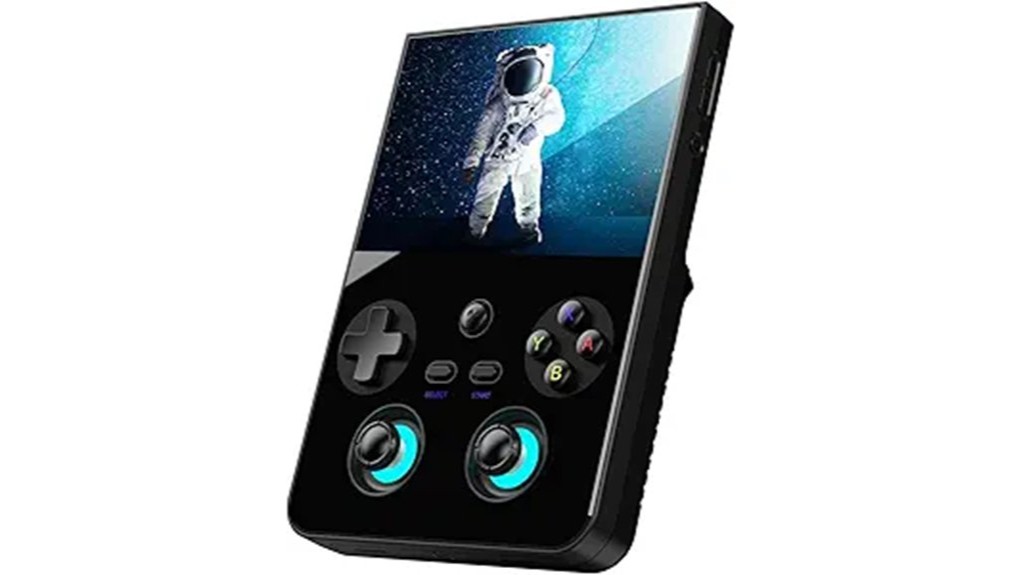
If you want a compact Android handheld that handles modern emulation, Android gaming and PC streaming without compromise, the RG477V’s Dimensity 8300, 8GB LPDDR5X and UFS 4.0 storage make it a clear choice—especially if you value 5G, Wi‑Fi 6E and HDMI output for low-latency cloud or Moonlight play.
You’ll get a 4.7-inch 1280×960 OCA display, Mali‑G615 MC6 GPU and expandable TF storage to 2TB, so you can carry a vast library.
Active cooling, 5500mAh battery and precise Hall sticks keep sessions stable.
If you want freedom from consoles and sluggish streaming, this device still delivers.
Best For: Enthusiasts wanting a compact Android handheld that reliably runs modern emulation, cloud/PC streaming and mobile/Android games with strong connectivity (5G, Wi‑Fi 6E) and expandable storage.
Pros:
- Powerful Dimensity 8300 + 8GB LPDDR5X and UFS 4.0 give smooth performance for emulation, Android titles and Moonlight streaming.
- Compact 4.7″ 1280×960 OCA display, precise Hall joysticks, 6-axis gyroscope and active cooling make for comfortable, accurate longer sessions.
- Robust connectivity (5G, Wi‑Fi 6E, Bluetooth 5.3), HDMI/USB‑C 1080p output and TF expansion to 2TB support large libraries and low‑latency streaming.
Cons:
- Small 4.7″ screen may be too cramped for some modern mobile games or less portable-first use cases.
- Battery life (~7 hours) can be limited under heavy emulation/streaming despite the 5500mAh pack and active cooling.
- No preloaded software or games and Android handheld ecosystem fragmentation may require more setup and tweaking for optimal emulation/streaming.
Evaluation Criteria: Price, Emulation, Ergonomics, Battery, and Support
You’ve seen what the RG477V offers on paper and in practice; now judge it against the metrics that actually matter when choosing a handheld: price, emulation capability, ergonomics, battery performance, and ongoing support.
You’ll weigh price comparison and user reviews, not hype. Compare emulation across cores, check frame timing, and confirm shader/upsampling support. Test grip comfort for long sessions and button placement for vertical layouts. Measure real-world battery runtime under native and emulated loads. Evaluate firmware update cadence, community tools, and spare-part availability — liberation comes from devices you can repair and customize.
| Criterion | What to measure | Pass/Fail |
|---|---|---|
| Price | MSRP vs market | |
| Emulation | Core compatibility | |
| Ergonomics | Comfort/time | |
| Battery | Runtime/Watt | |
| Support | Updates/parts |
Key Hardware and Firmware Changes (And Why They Matter)
Because hardware revisions and firmware updates change how the RG477V actually behaves in your hands, you should treat them as core features rather than afterthoughts.
You’ll notice hardware upgrades like reinforced shoulder switches, a stiffer D-pad, and improved cooling that reduce thermal throttling and extend usable session times. Those are tangible freedoms: you can play longer and mod confidently.
Firmware improvements deliver the other half — precise input mapping, rollback netcode for homebrew online play, and streamlined boot options that respect your choice of OS.
Together they unlock consistent behavior across units, simplify development, and lower the barrier to customizing software.
If you want liberation from flaky performance and locked-down firmware, focus on both hardware upgrades and firmware improvements when choosing your RG477V.
Performance: Vertical Shooters, Arcade Ports, and Ergonomics
When you push the RG477V into high-action vertical shooters and arcade ports, its CPU/GPU balance plus cooling determine whether you get steady frame pacing or jittery slowdowns.
You’ll notice consistent vertical gameplay when the SoC maintains clock ceilings under sustained load; thermal throttling is the enemy of tight shooter mechanics.
The handheld’s controller layout and thumbstick deadzone tuning affect input fidelity — no liberation if your inputs lag.
Emulation profiles that prioritize single-threaded CPU timing for shmups reduce stutter, while GPU-bound ports benefit from the device’s higher-frequency cores.
You can tweak governor settings, enable frame smoothing, and choose cores for foreground threads to preserve rhythm.
Ergonomics favor long sessions: weight distribution and button placement keep you free to play longer without compromise.
RG477V vs Newer Vertical Handhelds : Who Should Buy, Recommended Models, and Where to Buy
Curious whether the RG477V still makes sense next to newer vertical handhelds? You’ll judge by specs and use-case:
rg477v features like solid thermals, sharp 4:3 screen scaling, and reliable button mapping keep it viable for classic shmups and vertical gaming libraries. If you value open firmware, proven community builds, and long-term parts availability, buy the RG477V.
If you want newer SOC efficiency, brighter OLEDs, or native 16:9 vertical-port mods, opt for recent entrants from Anbernic’s rivals or boutique makers.
Recommended models: RG477V for stability; alternative vertical-focused units with updated SoCs and OLEDs for future-proofing.
Where to buy: official Anbernic store, reputable importers, and verified community sellers on forum marketplaces. Compare firmware support before purchasing.
Frequently Asked Questions
Can the RG477V Run Native Android Apps and Streaming Services?
Yes — you can run many native Android apps, though Android app compatibility varies by build; streaming service performance depends on firmware, codecs, and network, so you’ll test and tweak settings to maximize playback and freedom.
What Storage Expansion Options Does the RG477V Support?
It supports microSD expansion up to high storage capacity (typically 512GB–1TB depending on firmware), plus internal eMMC; you’ll use expandable memory for ROMs, media, and apps, maintaining freedom via removable storage.
Are Replacement Batteries and Spare Parts Readily Available?
Yes — you’ll find replacement options and spare parts from third‑party sellers and community groups; battery longevity varies, so you’ll swap cells or upgrade packs yourself, keeping freedom to repair and extend device life.
Does the Device Support Wired Multiplayer or LAN Play?
Like a locked door swung open, you can use wired connections for multiplayer gaming: the unit supports wired LAN via USB-C adapter and direct controller links, so you’ll rig stable sessions and free yourself from wireless limits.
How Does the RG477V Handle Firmware Updates and Rollback?
You get reliable OTA and manual firmware updates, with clear rollback via backup images; firmware stability is strong, update frequency is moderate, and you’ll retain control to revert or flash custom builds for full liberation.
Conclusion
So is the RG477V still worth your money in 2026? If you prioritize authentic vertical-shooter feel, solid arcade ports, and a compact, well-balanced shell, it remains a technically sound pick—especially if you find one at a discount. Just remember its battery and firmware limitations compared with newer models. If you want maximum longevity, grab a newer handheld with bigger battery and active dev support; if not, the RG477V still delivers focused, efficient performance.
[…] Anbernic RG477V in 2026: The Ultimate Vertical Retro Handheld? […]